Sonny Rollins, jazz’s last living Saxophone Colossus, dies at 95
By Jonsaba Jabbi2026/05/26
Sonny Rollins (1930-2026)
Credit:John Abbott
Sonny Rollins, one of the last remaining jazz greats of the 20th century, has passed away at the age of 95. The news of his death was confirmed by his agent, Terri Hinte, on Monday evening.
Born Walter Theodore Rollins on September 7, 1930 in New York City to parents from the Virgin Islands, Rollins came from a musical family with . He was gifted his first saxophone as a child and started the playing the piano around the same time, at the request of his parents. However, the saxophone came calling and he officially started playing the alto saxophone as a teenager followed by the tenor saxophone in 1946.
Drawing from inspiration from the jazz greats from his day such as Louis Jordan and Coleman Hawkins, Rollins was mentored by Theolonius Monk and would later work alongside him as a sideman. After graduating from high school in 1948, Rollins officially entered the jazz world professionally performing as a sideman for scat singer Babs Gonzales, landing his first recording in 1949. He would later record with Bud Powell, Fats Navarro and Roy Haynes before getting arrested for armed robbery in 1950. He would spend ten months on Rikers and would be in and out of jail over the next couple of years, struggling with drug addiction, until he started recording with Miles Davis in 1954, resulting in the album Miles Davis with Sonny Rollins. He would later join the Miles Davis Quintet in the summer of 1955 followed by Clifford Brown-Max Roach Quintet.
His first album, Sonny Rollins with the Modern Jazz Quartet, released in 1956, was a compilation of songs recorded between 1951-1953 under Prestige Records. But it was the highly acclaimed Saxophone Colussus (1956), featuring the calypso-infused “St. Thomas,” that catapulted Rollins into stardom.
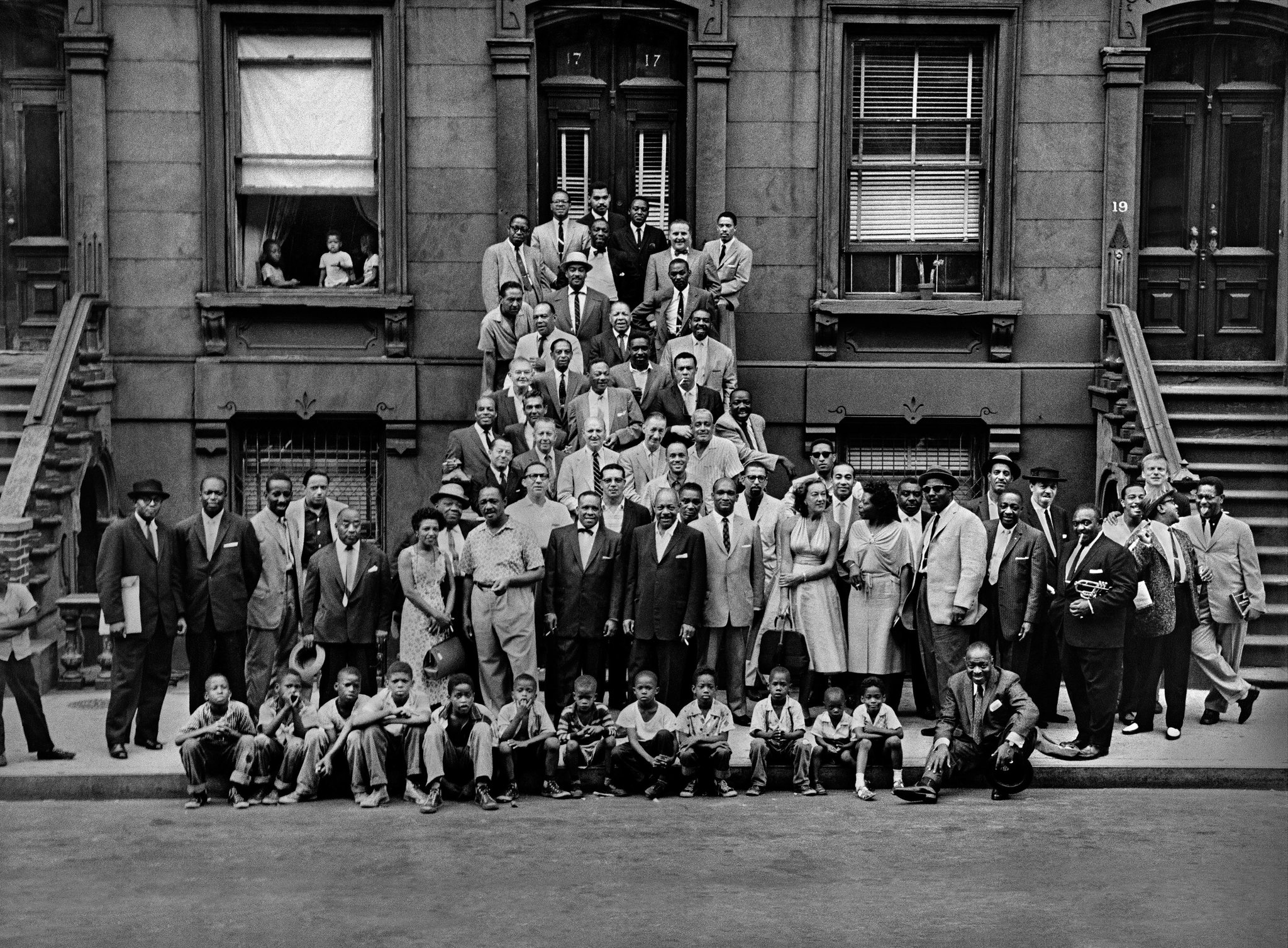
Credit: A Great Day in Harlem by Art Kane
On August 12, 1958, Rollins was one of 57 jazz musicians featured in the legendary A Great Day in Harlem, photographed by Art Kane for Esquire Magazine’s September Issue. Prior to his death, Rollins was last surviving musician from the photograph.
In 1959, frustrated with his growing popularity and the limitations of his musical practice, Rollins embarked on the first of many sabbaticals throughout his career. ““I was getting very famous at the time and I felt I needed to brush up on various aspects of my craft,” Rollins said in an interview. “I felt I was getting too much, too soon, so I said, wait a minute, I’m going to do it my way. I wasn’t going to let people push me out there, so I could fall down. I wanted to get myself together, on my own.”
In a career spanning 70 years, Rollins released over 60 albums as a bandleader including Tenor Madness (1956), A Night at the Village Vanguard (1957), Freedom Suite (1958) and The Bridge (1962) . He even created the technique “strolling” where his saxophone solos was accompanied with drums and bass with no piano, which was heard on his 1957 album Way Out West and A Night at the Village Vanguard. His collaborations were many, including Ornette Coleman, Abbey Lincoln, Dizzy Gillespie, Max Roach, McCoy Tyner, Frank Zappa and The Rolling Stones, who Rollins was featured on their 1981 album, Tattoo You.
“The music I play is too big to be put into any one style,” Rollins expressed in an interview in 2002. “Every time I pick up the horn, I want to hear something fresh.”
A NEA Jazz Master, Kennedy Center Honoree and two-time GRAMMY winner, Sonny Rollins was the first jazz musician to receive Edward MacDowell Medal for achievement in the arts in 2010. He retired from playing in 2012 and spent the remainder of his life in Woodstock, New York where he passed on Monday.
Whenever I reached out to Sonny and his team for some sort of reaction about something, whether it was an audio clip about Oscar Peterson or an interview with Ralph [Benmergui], he was there and always willing to engage and participate,” says Voice Tracks host and former JAZZ.FM91 Creative Director Dani Elwell. “What a blessing he was.”
We remember the life and legacy of Sonny Rollins with this quote from Dinner Jazz host John Devenish: “The cool, the intellectual kind of focused intelligence, a generational swagger, and then the ability to find solace and spiritual retreat in the midst of the mass that is a never ending pulsing of urban energies. There will be others, but none again like him.”